

Financial advisors often assume that physicians think about money the same way other professionals do.
Logic suggests that But physicians are different.
Doctors spend more than a decade training in an environment where money is rarely discussed openly.
When they begin earning high incomes, they bring with them complex beliefs about service, success, and identity.
Understanding these beliefs is critical for advisors who want to build strong relationships with physician clients.
One of the most useful frameworks for understanding physician financial behavior is a simple model I call the four financial identities of physicians.
This model separates financial reality from financial perception.
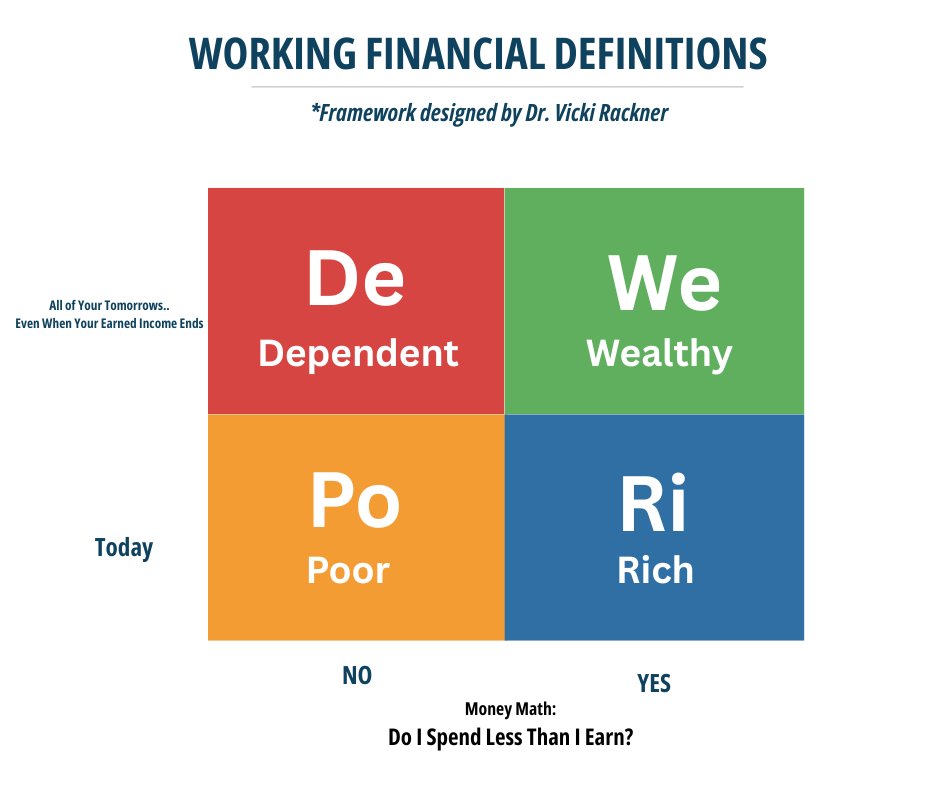
Rich vs Poor: The Math of Money
Let’s begin with a simple definition.
You are rich if you can comfortably pay your bills this month.
This is purely mathematical.
Money coming into your life exceeds money leaving your life.
You spend less than you earn.
You are poor if the opposite is true.
Notice something important.
This definition has nothing to do with income level.
A physician bringing home $400,000 who spends $420,000 is mathematically poor.
A physician bringing home $200,000 who spends $150,000 is mathematically rich.
Being rich is a snapshot in time.
Wealth: The Long View
Wealth is something different.
Wealth is the ability to string together a lifetime of rich months even if your earned income ended today.
In other words, wealth is the ability to sustain your lifestyle indefinitely through investments and assets.
This definition of wealth is also mathematical.
But wealth is about more than numbers.
It is also shaped by the story people tell themselves about those numbers
The Satisfaction Axis
Now add a second dimension life satisfaction.
How does the physician feel about their life?
Satisfied or dissatisfied.
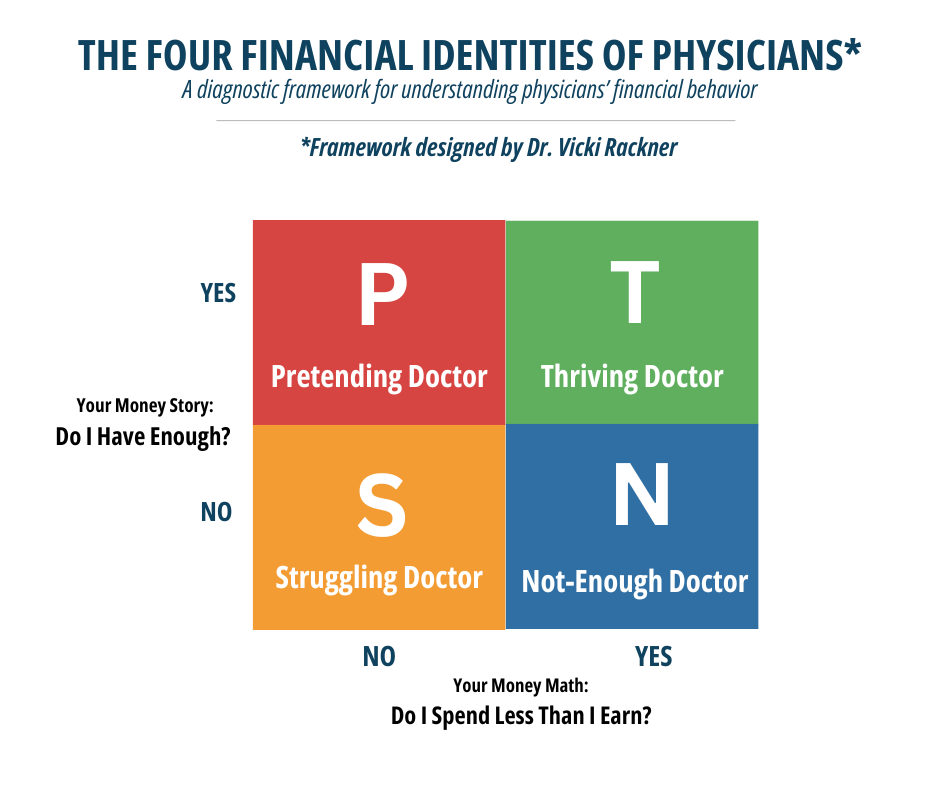
When you combine financial reality with life satisfaction, four distinct physician identities emerge.
The Four Financial Identities of Physicians
Thriving Doctors (Rich and satisfied)
Thriving doctors spend less than they earn and feel satisfied with their lives.
Their financial reality and identity are aligned.
Most doctors aspire to join this group.
Advisors can help thriving doctors think more intentionally about their future by asking questions such as:
• What experiences matter most to you over the next decade?
• What would financial success look like twenty years from now?
• What would you like your money to make possible for others?
Not-Enough Doctors (Rich but dissatisfied)
Not-Enough Doctors spend less than they earn but still feel financially insecure.
An estate planner who works with ultra-wealthy families once shared something fascinating with me.
When he refers to his clients as rich, they almost always respond:
“I’m not rich.”
When he asks how much they would need to feel rich, the answer is almost always:
“Three times as much as I have now.”
This reveals a powerful truth.
Financial security is psychological as well as mathematical.
Advisors can help these physicians update their perspective by asking questions such as:
• At what point would you consider yourself financially secure?
• How often do you revisit how far you’ve already come?
• If a colleague had your financial position, what would you say to them?
Interestingly, Not-Enough Doctors may be the most coachable clients.
They already spend less than they earn. The foundation for wealth is already present.
What they need is clarity and confidence.
Pretending Doctors (Poor but satisfied)
Pretending Doctors spend more than they earn but maintain a high level of satisfaction.
They act rich but aren’t.
These physicians are living the Myth of the Rich Doctor.
From the outside, their lifestyle signals prosperity.
But the financial math often tells a different story.
Advisors can introduce financial awareness by asking questions such as:
• Have you ever calculated how much of your income you save each year?
• If your income stopped tomorrow, how long could your lifestyle continue?
• Would you be open to reviewing your financial numbers together?
Struggling Doctors (Poor and dissatisfied)
Struggling doctors spend more than they earn and feel dissatisfied.
These physicians already know something isn’t working.
Advisors can help by replacing shame with clarity.
Questions might include:
• Which financial decisions feel most stressful right now?
• If your financial life felt calmer a year from now, what would be different?
• What small financial change would make the biggest difference?
Where Do Most Physicians Fall?
In my experience, physicians tend to distribute roughly as follows:
25% Thriving Doctors
50% Not-Enough Doctors
10% Pretending Doctors
15% Struggling Doctors
Precise data is difficult to obtain because wealth is largely invisible and physicians rarely discuss money openly.
However, surveys consistently show that many physicians feel financially insecure despite high incomes.
This suggests that the Not-Enough Doctor identity may be the most common experience among physicians.
The Advisor’s Opportunity
Each quadrant represents a different financial story.
Financial advisors who recognize these stories can tailor their conversations accordingly.
Your role is not just to manage assets.
It is to help physicians align their financial reality with the identity they carry about money.
When those two things align, physicians move toward the quadrant most of them ultimately seek:
The quadrant of the Thriving Doctor.