
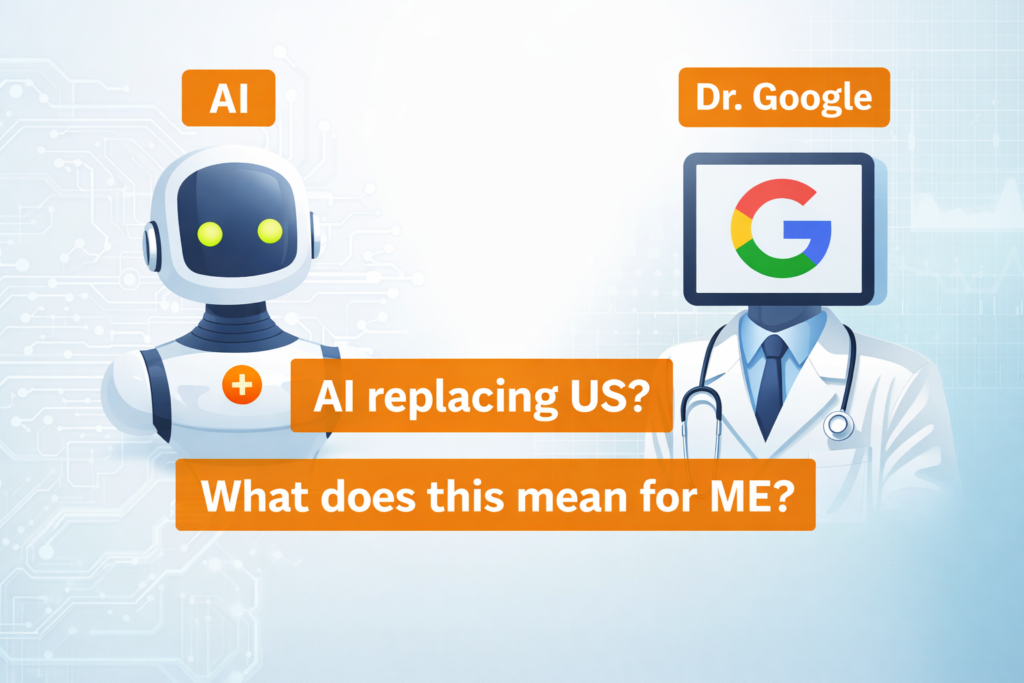
Financial advisors are asking a quiet question:
Is AI replacing financial advisors?
As artificial intelligence reshapes financial services, many advisors feel the same uncertainty physicians experienced when “Dr. Google” first entered the exam room.
Decades ago, physicians asked a similar question and the answer from that era may reveal what AI truly means for financial advisors today.
What Dr. Google Really Changed
In the late 1990s, medical information stopped being scarce.
Before the internet, physicians searched journals with the help of medical librarians, and we understood the nuance. Patients, however, did not have access to that language.
Then health websites began translating complex medical information into plain English. As a result, symptoms could be entered into search bars within seconds.
Patients started asking:
“What does this mean?”
Often, they were wrong about their diagnosis. More importantly, they were anxious.
Over time, something became clear:
Information can be medicine.
At the right dose, it helps.
However, too much can cause harm.
Many patients weren’t safer after researching. In fact, they were more overwhelmed. Instead of needing more data, they needed interpretation.
Ultimately, they were trying to answer a deeply personal question:
“What does this mean for me?”
They weren’t trying to replace physicians. Rather, they were trying to feel safer.
The Identity Shift
For years, many physicians had unconsciously believed:
“My authority comes from knowing more than you.”
However, when patients began arriving informed, that identity cracked.
Some doctors became defensive, while others chose to evolve.
Those who adapted realized that once information was no longer scarce, authority had to come from somewhere else. Gradually, it began to come from:
Interpretation
Experience
Context
Relationship
As a result, medicine split into two paths:
Transactional, defensive care
Relational, interpretive care
The second path restored the human role that information alone could never fulfill.
The Parallel to Financial Advisors and AI
Now consider artificial intelligence in financial services.
Today, AI can:
Run projections
Compare strategies
Explain tax rules
Generate financial plans
Meanwhile, clients are researching online, listening to podcasts, and experimenting with AI tools. By the time they arrive in your office,
they are already informed sometimes misinformed, and often anxious.
When clients search:
“Should I retire early?”
“Is my portfolio too risky?”
“How much is enough?”
They are not simply looking for calculations. Instead, they are searching for certainty and, even more deeply, for safety.
AI Is Not Replacing Financial Advisors
The real question isn’t whether AI is replacing financial advisors. Rather, it’s whether advisors understand what clients truly need.
Most financial plans do not fail because the math is wrong. Instead, they fail because fear overrides strategy.
Under stress, the safety brain freezes, the relief brain spends, and the planning brain disappears.
Although AI can provide information, it cannot regulate fear. It can generate a plan, yet it cannot interpret a client’s lived experience. And while it can simulate outcomes, it cannot answer the most important question:
“Am I going to be okay?”
That question is relational, not computational.
From Expert to Interpreter
In the past, expertise meant possessing knowledge. In the AI era, however, expertise means interpreting knowledge.
That is the identity shift.
If your authority depends on “I know more than you,” AI will feel threatening. On the other hand, if your authority depends on interpretation and emotional steadiness, AI becomes a tool.
Advisors who thrive in the AI era will not resist artificial intelligence. Instead, they will:
Use AI for efficiency
Elevate conversations from tactics to meaning
Recognize that anxiety drives financial behavior
Create psychological safety
Information abundance increases volatility. When markets move, data multiplies. As data multiplies, anxiety rises. And when anxiety rises, clients look for anchors.
In those moments, you become the anchor not because you know more, but because you help clients think clearly when they cannot.
A Final Perspective
When Dr. Google entered the exam room, it did not end medicine. Instead, it forced medicine to mature.
Today, artificial intelligence is doing the same for financial advisors.
AI is not replacing financial advisors. Rather, it is refining them.
The advisors who succeed will not compete with algorithms. Instead, they will do what algorithms cannot.
They will interpret.
They will steady.
And ultimately, they will help clients answer the most human question of all:
“What does this mean for me?”