
Artificial intelligence is changing the way financial advisors work.
Every week I hear another advisor say, “I used ChatGPT to write an email,” or “AI helped me brainstorm a webinar,” or “I asked AI to come up with marketing ideas.”
That’s wonderful.
But I’m beginning to notice two very different—and equally dangerous—mistakes advisors are making.
The first group refuses to use AI at all.
The second group gives AI far too much authority.
Neither approach will help you become the go-to financial advisor for doctors.
Instead, I believe the future belongs to advisors who understand one simple principle:
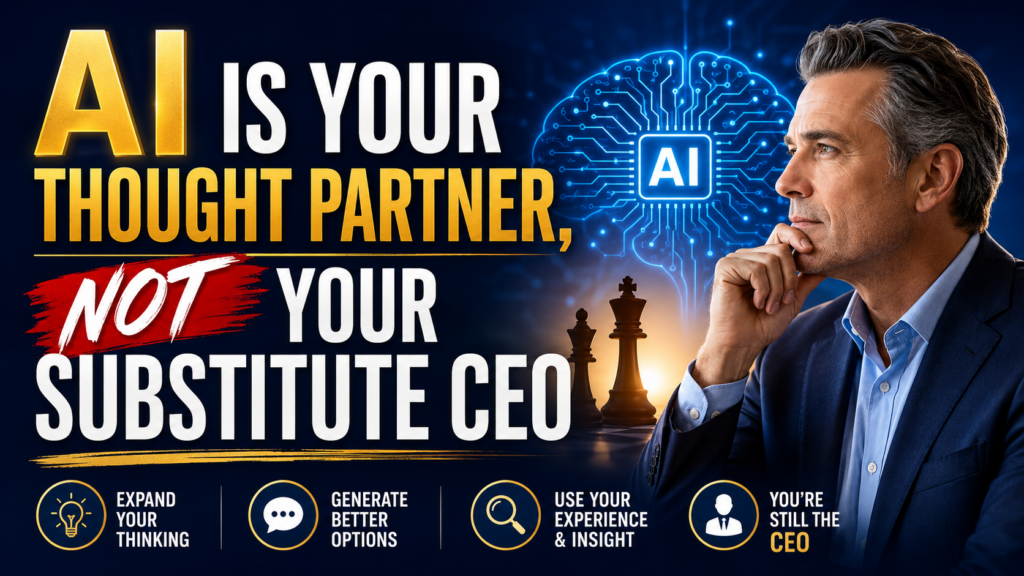
AI is your thought partner—not your substitute CEO.
The First Mistake: Refusing to Use AI
Some advisors are avoiding AI because it feels unfamiliar, overwhelming, or even threatening.
I understand.
Every major technological shift has created uncertainty.
But here’s the reality: AI is one of the most powerful thinking tools we’ve ever had.
It can help you:
- Brainstorm marketing campaigns
- Generate webinar ideas
- Draft emails
- Analyze competitors
- Organize research
- Create content faster
- Challenge your assumptions
If you’re not using AI, you’re making your job harder than it needs to be.
Last week, I showed how AI can help advisors evaluate different physician niches before investing time and money pursuing them. Rather than falling in love with an idea, AI can help you run the numbers, compare opportunities, and ask better questions.
That’s exactly how a thought partner should work.
The Second Mistake: Letting AI Become Your CEO
The opposite mistake is just as dangerous.
Some advisors assume that because AI is intelligent, it must always be right.
They ask a question.
AI gives an answer.
They move forward without questioning it.
That’s a mistake.
AI doesn’t know your strengths.
It doesn’t know your clients.
It doesn’t know your values.
It doesn’t know your history of success.
And it certainly doesn’t know the subtle clues that experienced professionals recognize almost instinctively.
The Patient Who Came in for a Hernia
Years ago, while I was still practicing surgery, I met with a patient who had been referred to me for a routine hernia repair.
We completed the consultation.
We discussed the operation.
I answered his questions.
The visit was over, and I started walking toward the door.
Out of the corner of my eye, I noticed something.
The patient removed his baseball cap, tucked something underneath it, and repositioned the cap on his head.
I stopped.
I turned around and asked,
“What’s under your cap?”
He hesitated for a moment.
Then he slowly removed the cap.
Underneath was a large growth—about the size of a mandarin orange.
In that instant, everything changed.
The hernia was no longer his most important problem.
The mass was.
We changed the treatment plan completely.
I’ve thought about that encounter many times over the years.
Not because I was smarter than anyone else.
But because experience had taught me to notice something that didn’t fit the pattern.
Great Advisors Notice What Others Miss
The best financial advisors do exactly the same thing.
A physician casually mentions that they’re exhausted.
A client hesitates before answering a question.
Someone laughs while talking about retirement—but their eyes tell a different story.
Another client casually says,
“I’m thinking about cutting back.”
Most people hear the words.
Great advisors hear the meaning.
Those seemingly insignificant comments often reveal the real issue the client hasn’t yet articulated.
That’s leadership.
AI Can Generate Ideas. You Create Insight.
AI can generate one hundred marketing campaigns.
AI can recommend email subject lines.
AI can help you outline a webinar.
AI can summarize research in seconds.
But AI cannot determine which opportunity is best for you.
It doesn’t know whether a strategy fits your personality.
It doesn’t know whether it aligns with your strengths.
It doesn’t know whether your team can execute it.
And it doesn’t know how physicians think unless you teach it.
That’s where your judgment becomes your greatest competitive advantage.
The Future Isn’t Human vs. AI
Too many people frame this discussion as though humans and AI are competing.
I don’t see it that way.
I think the most successful advisors will combine the strengths of both.
Use AI to expand your thinking.
Use AI to generate options.
Use AI to challenge your assumptions.
Then step back.
Think.
Evaluate.
Prioritize.
Decide.
Those are leadership skills.
Those are CEO skills.
AI should never replace them.
Why This Matters More Than Ever
Today’s clients don’t need more information.
Information is everywhere.
What they need is someone who can help them make wise decisions in the face of uncertainty.
That’s what great financial advisors do.
That’s why physicians value trusted advisors.
And that’s why your experience, judgment, and discernment will become even more valuable as AI becomes more powerful.
The advisors who thrive over the next decade won’t simply be the ones who use AI.
They’ll be the ones who know how to use AI.
They’ll understand when to trust it.
When to question it.
When to ignore it.
And when to recognize the subtle clue that changes everything.
Join Me Next Week
In my upcoming webinar, I’ll show you how I’m using AI as a strategic thought partner to help financial advisors attract, engage, and serve more doctor clients.
You’ll discover practical ways to combine AI with physician psychology, proven marketing strategies, and decades of real-world experience to build a physician-focused practice that stands out in an increasingly competitive marketplace.
AI is an extraordinary tool.
But remember—
You’re still the CEO.