
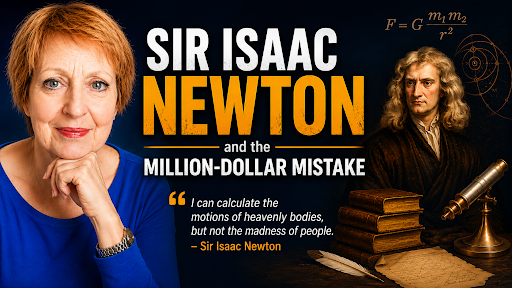
“I can calculate the motions of the heavenly bodies, but not the madness of people.”
— Sir Isaac Newton
If you’ve worked with physicians for any length of time, you’ve probably heard some version of this confession.
“I knew better.”
“I can’t believe I invested in that.”
“I should have seen it coming.”
Sometimes it’s a speculative real estate investment. Sometimes it’s cryptocurrency. Sometimes it’s a private placement that promised extraordinary returns. Sometimes it’s simply buying at the top of the market and selling in a panic.
As financial advisors, our instinct is often to explain what happened. We review the charts. We discuss diversification. We revisit the investment policy statement.
Those conversations are important.
But they’re often not the conversation your physician client needs first.
Before physicians can hear your advice, they need to believe one thing:
“I’m not the only smart person who has ever made a financial mistake.”
That’s where Sir Isaac Newton comes in.
The Smartest Man in England
Isaac Newton wasn’t simply intelligent. He fundamentally changed the way we understand the universe.
He discovered the laws of motion.
He explained gravity.
He invented calculus.
If anyone should have been able to outsmart the financial markets, surely it was Isaac Newton.
Yet in 1720, Newton became caught up in one of history’s greatest investment bubbles—the South Sea Bubble.
Early in the year, he did exactly what a disciplined investor should do.
He sold his shares.
He doubled his money.
Most investors would have celebrated and moved on.
Newton didn’t.
As the price continued climbing, he watched friends, colleagues, and neighbors become even wealthier. The excitement was contagious. The fear of missing out became overwhelming.
Eventually, Newton bought back into the stock—at a much higher price.
Then the bubble burst.
He lost the equivalent of several million dollars in today’s currency.
Years later, he reportedly remarked:
“I can calculate the motions of the heavenly bodies, but not the madness of people.”
That quote has survived for more than 300 years because it captures a timeless truth.
His problem wasn’t mathematics.
It was human psychology.
Your Physician Clients Already Know the Rules
Here’s what makes this story so powerful.
Most physicians already know the principles of sound investing.
They know they shouldn’t chase returns.
They know diversification matters.
They know markets fluctuate.
Knowledge wasn’t Newton’s problem.
And it probably isn’t your client’s problem either.
Instead, your physician clients are vulnerable to the same emotions that affect every investor.
- Fear of missing out
- Regret
- Overconfidence
- Optimism
- Herd mentality
These aren’t signs of low intelligence.
They’re signs of being human.
The Hidden Emotion: Shame
One of the biggest surprises I’ve encountered while interviewing physicians about money is how much shame surrounds financial mistakes.
Doctors are trained to be competent.
Prepared.
Decisive.
When they make an error, they often replay it repeatedly in their minds.
Financial mistakes are no different.
Many quietly conclude:
“I should have known better.”
That belief becomes an obstacle.
Not because it changes the past.
Because it makes physicians reluctant to discuss their mistakes openly.
They may avoid calling their advisor.
Delay making needed changes.
Or refuse to sell a losing investment because selling would require admitting they were wrong.
Notice what has happened.
The investment is no longer the problem.
Identity is.
Stories Lower Defenses
When advisors respond with data, clients often defend themselves.
When advisors respond with stories, clients become curious.
Imagine the difference between these two conversations.
Conversation #1
“You shouldn’t have invested such a large percentage of your portfolio in one speculative investment.”
Technically correct.
Emotionally ineffective.
Conversation #2
“Can I tell you a fascinating story? Even Isaac Newton got caught in one of history’s greatest investment bubbles.”
Now the conversation changes.
You’re no longer talking about their mistake.
You’re talking about human nature.
The physician’s shoulders relax.
They’re no longer being judged.
They’re learning.
Stories normalize experiences that people believe are unique.
That’s why they are so powerful.
The Advisor’s Greatest Value
Financial advisors certainly add value through investment management, tax planning, and retirement strategies.
But one of your greatest contributions is something far less tangible.
You help physicians make better decisions during emotionally charged moments.
That’s not simply financial expertise.
That’s behavioral leadership.
Newton’s story reminds us that intelligence alone isn’t enough.
We all need systems.
We all need perspective.
We all need someone who can help us think clearly when emotions threaten to take over.
Three Questions to Ask Your Physician Clients
After sharing Newton’s story, consider asking one of these questions.
1. “Have you ever made a financial decision that looked completely different in hindsight?”
This invites reflection without assigning blame.
2. “What do you think was driving your decision at the time?”
Now you’re exploring psychology instead of performance.
3. “What would help you make that kind of decision differently in the future?”
The conversation shifts from regret to growth.
That’s where real progress begins.
The Lesson Newton Teaches Us
Isaac Newton didn’t fail because he lacked intelligence.
He failed because he was human.
Your physician clients are human too.
They’ll make excellent decisions.
They’ll make regrettable decisions.
The goal isn’t perfection.
The goal is helping them recover, learn, and move forward with confidence.
Sometimes the most valuable thing you can offer isn’t another market forecast.
It’s the reassurance that even one of history’s greatest minds struggled with the same emotions they experience today.
Reflection for Advisors
The next time a physician tells you about an investment they regret, resist the temptation to immediately explain what happened.
Instead, tell them a story.
You may discover that stories accomplish something charts never can.
They replace shame with perspective.
And once shame is gone, better financial decisions become possible.
About the Author
Dr. Vicki Rackner is a retired surgeon and founder of Engaging Doctors, where she helps financial advisors attract, engage, and serve more physician clients. Through stories, psychology, and decades of experience working with physicians, she teaches advisors how to build deeper relationships by understanding the person behind the portfolio.